Yoga Planner Journal: The Strategic Interior for Publishing Success
The journey from a concept to a polished, published book involves a series of crucial decisions, each impacting the final product's quality, marketability, and ultimately, its success. For independent publishers focusing on the wellness and self-care niche, the Yoga Planner Journal - Kdp Interior represents not merely a template, but a strategic asset. It is a pre-designed, print-ready interior that eliminates the technical barriers of book formatting, allowing creators to channel their energy into content, branding, and audience connection. Its utility lies in its thoughtful construction: it provides a structured framework for a yoga planner journal notebook while offering the complete flexibility needed for personalization and professional presentation.
Strategic Foundations: What This Interior Provides
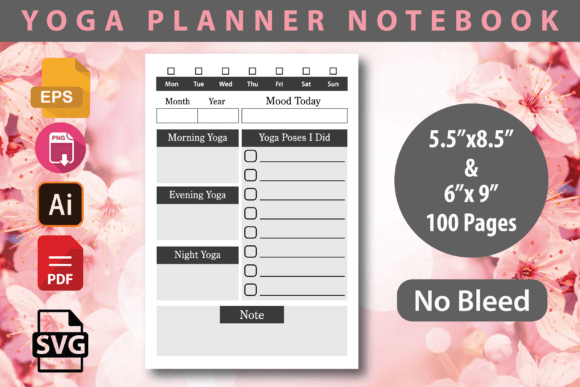
At its core, the Yoga Planner Journal - Kdp Interior is a comprehensive package designed for the practical realities of self-publishing, particularly on platforms like Amazon Kindle Direct Publishing (KDP). The included files—PDF, AI, EPS, SVG, and PNG—are not just digital deliverables; they are tools for different phases of the publishing process. The high-quality, 300 DPI print-ready PDF is the final vessel for upload, engineered to meet KDP's stringent specifications to avoid rejection. The AI and EPS template files are the strategic backbone, offering scalable, editable vectors for creators who wish to modify layouts, fonts, or graphic elements to align with a unique brand identity. This dual nature—ready-to-use and fully customizable—makes it a versatile solution for both time-pressed entrepreneurs and meticulous designers.
The specified trim sizes of 6x9 and 5.5x8.5 inches without bleed are a deliberate choice. These are popular, cost-effective dimensions for paperback journals, balancing readability with production economics. By providing both, the interior accommodates different aesthetic and functional preferences, allowing the publisher to make a market-informed decision on which format best suits their target audience's expectations.
Aligning Product with Purpose: The Role of Planning in Publishing
Publishing a yoga planner is not just about selling pages; it's about providing a tool that facilitates a user's practice, mindfulness, and personal growth. Therefore, the interior itself must be an instrument of clarity and ease. A well-structured planner interior guides the user logically—from monthly goals to weekly schedules, daily session logging, and progress reflection. Using a professionally designed Yoga Planner Journal - Kdp Interior ensures this flow is intuitive, which directly enhances the customer experience. A frustrating, poorly laid-out interior can undermine the very purpose of a planner, leading to negative reviews and diminished brand reputation.
For the independent publisher, this translates to long-term results. A positive user experience fosters repeat customers, word-of-mouth referrals, and the establishment of a trusted name within the wellness publishing space. The interior, therefore, is a critical component of product strategy, influencing operational efficiency (smooth uploads, no rejections), customer satisfaction, and brand equity.
Intentional Use: Moving Beyond Random Selection
The decision to use a pre-made interior should be a strategic one, not a default. Before relying on the Yoga Planner Journal - Kdp Interior, consider your overarching goals. Is your primary aim to quickly test a market niche with a professional-looking product? Are you building a series of wellness journals under a cohesive brand that requires consistent interior design? Or are you a yoga instructor creating a custom tool for your clients that needs a unique, personalized touch? The answers dictate how you approach the template.
For rapid market entry and validation, the ready-to-upload PDF is invaluable. It allows you to bypass the weeks of learning design software and formatting rules, focusing instead on cover design, marketing copy, and launch strategy. For branding and series development, the AI and EPS templates are essential. They enable you to establish a signature layout—a specific typeface for headers, a unique icon set for section markers, a proprietary color palette—that becomes recognizable across your entire product line. This conscious use turns a generic template into a branded asset.
Practical Considerations and Planning Tips
- Audience Analysis: Before customization, study your target users. Do practitioners prefer minimalist designs or inspirational graphics? Should daily entry space be ample for detailed notes or concise for quick logging? Align your modifications with these insights.
- Content Mapping: Plan your journal's content flow on paper first. Decide the sequence: perhaps an annual intention page, followed by monthly calendars, weekly breakdowns with pose lists, and daily pages for breathwork and reflection notes. Ensure the provided interior structure supports or can be adapted to this map.
- Technical Safeguards: Always use the PDF file for final KDP upload. Preview it thoroughly using KDP's online previewer. The assurance that the interior is "100 tested for KDP uploads" mitigates the significant risk of publication delays and technical rejections, a common operational hurdle for new publishers.
- Brand Integration: If using the editable templates, incorporate elements from your cover design—colors, fonts, stylistic motifs—into the interior. This creates a harmonious, professional product that reinforces brand identity.
Risks of Uncontextualized Use
While the Yoga Planner Journal - Kdp Interior is a robust tool, employing it without clear goals or context carries subtle risks. The foremost is product homogenization. Using the template exactly as provided, without any customization, may result in a journal that looks identical to others in the marketplace, making differentiation difficult. In a competitive niche, distinctiveness is a key driver of discovery and sales.
Another risk is misalignment with audience needs. Assuming the default layout perfectly suits your specific user base can lead to a product that feels generic or impractical. For example, a community focused on rigorous Ashtanga yoga might need a planner with emphasis on sequence repetition and strength progression, which might require layout adjustments from a more general, holistic template. Without intentional adaptation, you risk delivering a tool that is merely adequate, not optimally helpful.
The Long-Term Value of a Strategic Asset
Viewing this interior as a long-term strategic asset changes the investment perspective. For a freelance graphic designer offering publishing services to wellness coaches, this template package becomes a reusable foundation for client projects, dramatically reducing project timelines and increasing service scalability. For a blogger expanding into physical products, it provides a credible, professional-grade starting point, elevating the product line's perceived value.
The included SVG and PNG files further extend utility. They allow for the extraction of individual design elements—like decorative borders or section headers—for use in marketing materials, social media graphics, or complementary digital products, creating a cohesive ecosystem around the core journal. This strategic leveraging of one asset across multiple touchpoints maximizes return on effort and fosters a unified customer experience.
Conclusion: A Tool for Empowered Creation
Ultimately, the Yoga Planner Journal - Kdp Interior is more than a collection of files; it is an empowerment tool for independent publishers. It democratizes professional book production, turning a complex technical process into a manageable, creative one. Its strategic value is unlocked when it is used intentionally—as a launchpad for market testing, a canvas for brand building, or a reliable component in a scalable publishing operation. By grounding its use in realistic goals—whether that's achieving better operational results through guaranteed upload compatibility, enhancing customer experience through thoughtful layout, or building long-term brand recognition through customized design—publishers transform a simple interior into a cornerstone of their publishing success.