Navigating the Square Maze Puzzle as a Versatile Kids Activity
In the expansive world of children's puzzles and educational activities, a distinct format has carved out its own niche. Square maze puzzles kids activity represents a focused and often underrated category within puzzle books and printable resources. Unlike sprawling, thematic mazes or intricate labyrinth illustrations, a square maze confines the challenge within a defined, symmetrical border. This constraint is not a limitation but rather the source of its unique cognitive appeal and practical utility for parents, educators, and self-publishing creators.
Defining the Distinct Appeal of the Square Maze Format
At its core, a square maze puzzle is a logical pathfinding challenge bounded by a perfect square. The activity involves tracing or drawing a line from a start point to an exit, navigating through deliberately placed barriers within the grid. What makes it distinct from other maze styles is its geometric purity and structural consistency. While circular or irregular-shaped mazes can feel artistic and freeform, the square maze presents a more ordered, almost architectural problem. This structure influences the child's approach to the puzzle, often encouraging a more methodical, step-by-step analysis of pathways compared to the instinctive exploration prompted by organic shapes.
The activity's value lies in its blend of simplicity and challenge. The clean lines and clear boundaries reduce visual clutter, making it accessible for younger children who might be overwhelmed by complex scenes. Yet, the internal path design can be crafted to offer significant difficulty, involving dead ends, loops, and strategic decision points that develop critical thinking, patience, and fine motor skills. This balance between accessible format and scalable difficulty is a key strength of the square maze puzzles kids activity.
Comparison with Other Puzzle Categories and Resources
When evaluating kids' activities, it's useful to consider how square mazes fit alongside other popular options. Compared to classic crossword puzzles or word searches, a square maze is purely visual-spatial and non-verbal, making it an excellent tool for pre-readers or children developing logical reasoning outside language contexts. Against the backdrop of free digital puzzle games, a physical square maze on paper offers a tactile, screen-free experience that encourages sustained focus without notifications or time limits—a valuable tradeoff in an increasingly digital childhood.
Within the maze genre itself, comparisons are insightful. Many children's puzzle books feature large, colorful illustration mazes where the path winds through a jungle or cityscape. These are fantastic for storytelling and engagement. The square maze, however, distills the logical core of the maze experience. It strips away the narrative layer to focus purely on the problem-solving mechanics. For a child who needs to practice systematic thinking without thematic distraction, or for an educator seeking to assess pure spatial reasoning, the square maze format can be a more targeted tool. It represents a choice between immersive, fun-focused play and disciplined, skill-focused practice; both have their place depending on the child's needs and the situation.
Strengths and Practical Applications
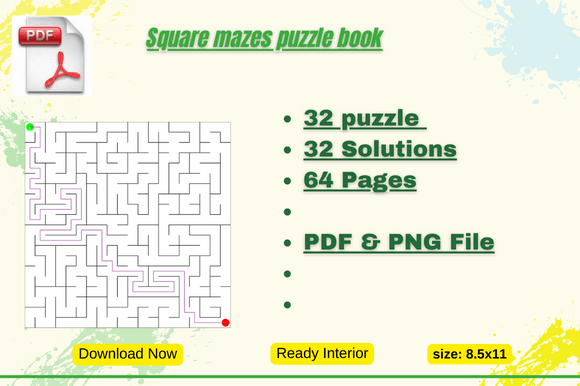
The primary strengths of a square maze puzzles kids activity are its versatility and clarity. Its neat format makes it easy to integrate into various settings. For teachers, it can be a quick warm-up exercise on a worksheet or a quiet time activity. For parents, it’s a portable, no-prep option for travel or waiting rooms. For creators designing resources for platforms like Amazon KDP (Kindle Direct Publishing), the consistent square shape simplifies layout design and ensures a professional, uniform look across an entire book interior, such as a collection offering 32 square mazes with solutions.
A well-designed set, like a KDP interior with 32 square mazes of new content, leverages these strengths. Offering one maze per page on an 8.5"x11" format provides ample space for solving without crowding, reducing frustration for small hands. Including solutions separately respects the child's independent effort while providing a necessary aid for tricky puzzles. This structure makes the resource self-contained and user-friendly, suitable for both home use and classroom stations.
Understanding Tradeoffs and Limitations
Every activity format involves tradeoffs, and the square maze is no exception. Its geometric austerity might be less immediately captivating to some children than a vibrant, character-filled maze. A child motivated by story or fantasy might initially find a plain square maze less engaging. This is a key decision factor: the square maze often excels in contexts requiring concentration and logic practice, but may need introduction or pairing with more thematic activities to spark initial interest in a child driven by narrative.
Another consideration is skill transfer. While square mazes excellently develop visual tracking, perseverance, and planning, they do not directly practice letter or number recognition like alphabet mazes or math puzzle paths. If the learning goal is multidisciplinary integration, a themed maze combining shapes with letters might be a better fit. However, for pure spatial reasoning and fine motor control, the focused nature of the square maze puzzle is arguably superior.
When Is a Square Maze Puzzles Kids Activity the Right Choice?
Identifying the best-fit situations can help in selecting resources. This activity format is particularly advantageous:
- For foundational skill building: When a child needs to develop basic problem-solving strategies without overlapping cognitive demands.
- In structured learning environments: Such as occupational therapy sessions or focused homeschooling modules where measurable progress in spatial awareness is a goal.
- As a reproducible resource: For creators and educators needing a clean, scalable activity that looks consistent across many pages and can be easily printed or published.
- For children who prefer order: Some young minds thrive on predictability and clear rules; the bounded square format can provide a comforting structure for their exploration.
A practical example: a parent comparing a busy "pirate ship adventure maze book" with a "KDP Interior Star Mazes Puzzle Book – 32 Mazes" might choose the former for weekend fun and the latter for daily morning routine practice. The square maze book offers a predictable, calm start to the day, while the adventure book serves as a reward or creative play.
Evaluating Quality and Scope in a Maze Collection
When researching or choosing a product like a 64-page book with 32 square mazes and solutions, several factors beyond the format itself come into play. The phrase "all square shaped maze of content is new generate" indicates originality, which is vital for avoiding repetition and maintaining challenge progression. A collection with new, uniquely generated mazes ensures each puzzle presents a fresh problem, preventing a child from simply remembering a pattern from a previous page.
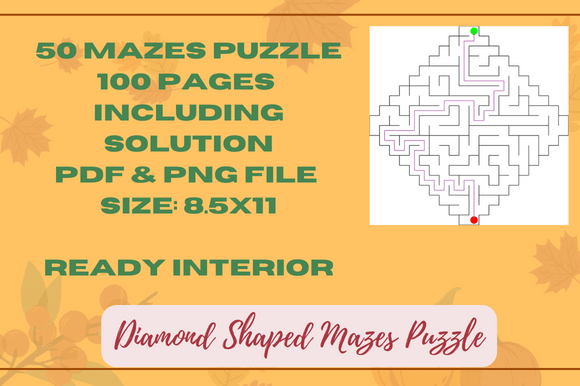
The inclusion of solutions, ideally on separate pages or at the end, is not merely a convenience but a pedagogical choice. It allows for self-correction and reduces dependency on adult help, fostering independence. The provision of both a PDF and a PNG file, as mentioned in some product descriptions, speaks to versatility for different uses: the PDF for seamless printing of the entire book, the PNG for possibly using individual mazes in digital apps or custom worksheets.
Comparing such a ready-to-upload KDP interior to assembling one's own mases from various online sources highlights another decision point. The curated collection offers guaranteed consistency in difficulty grading, uniform artwork quality, and professional layout (one maze per page, 8.5"x11"). The DIY approach offers ultimate customization but demands significant time for sourcing, difficulty balancing, and formatting. For the adult seeking a ready-made, sellable product or a time-efficient resource, the pre-designed interior is often the pragmatic alternative.
Scenarios Where Another Option Might Be Needed
Despite its utility, a dedicated square maze puzzles kids activity might not be the optimal resource in certain scenarios. If the primary goal is to reinforce a specific academic lesson—like a history unit—a maze woven into a relevant historical map would offer richer cross-curricular benefits. For group activities or cooperative play, a single-page square maze is inherently a solitary task; a large, communal maze poster might better serve the goal of social interaction and teamwork.
Furthermore, for children with significant visual processing challenges or very low frustration tolerance, the high concentration of lines in a complex square maze could be counterproductive. In such cases, alternatives with wider paths, fewer choices, or sensory-friendly colors might be necessary first steps before introducing the more structured square format. The decision hinges on aligning the activity's characteristics with the individual child's developmental stage and preferences.
Ultimately, the square maze puzzle stands as a specialized, efficient tool within the toolkit of child development resources. Its value is clearest when the objective is targeted cognitive exercise, professional resource creation, or providing structured, repeatable practice. By understanding its distinct place alongside more flamboyant or integrative alternatives, adults can make more informed choices—selecting the square maze puzzles kids activity for its strengths where they align with the need, and confidently choosing other formats when different goals take priority. This balanced evaluation leads to the most effective use of puzzles, not as a one-size-fits-all solution, but as a versatile component of a thoughtful learning and play environment.