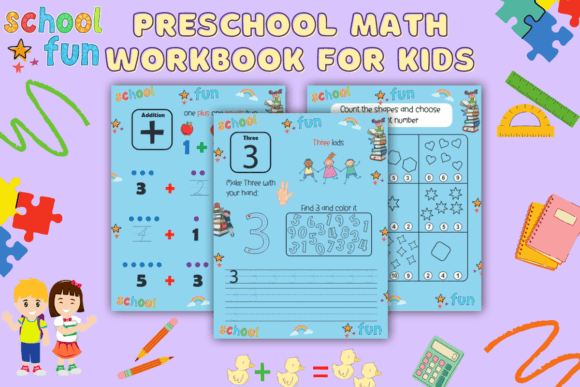
The Essential Framework: Understanding Modern Preschool Math Workbooks
In the foundational world of early childhood education, the tools we provide to young learners set the trajectory for their academic journey. A dedicated math workbook for preschoolers and kindergarten children is more than a simple collection of pages; it is a structured pathway designed to build numeracy, confidence, and cognitive skills. The evolution of these resources from basic printouts to sophisticated, editable educational packages reflects a deeper understanding of how children learn and the diverse needs of those who guide them.
Core Characteristics of a Contemporary Kindergarten Math Workbook
The anatomy of a high-quality workbook is defined by specific features that serve both the child and the educator or creator. A standard offering, such as a 54-page volume sized at the familiar 8.5 x 11 inches, provides ample space for progressive learning without overwhelming the young user. The inclusion of bleed in the design ensures that when printed, the colored pages and educational graphics appear professional and complete, with no awkward margins cutting into illustrations.
Content typically begins with the most fundamental concepts: number recognition and writing. These sections are not about rote repetition but about connecting symbol, quantity, and name. Following this foundation, the workbook logically introduces early mathematical operations. Simple addition and subtraction are presented in visual, context-rich ways, often using groups of friendly animals, fruits, or everyday objects. This approach aligns with the cognitive stage of kindergarten children, who benefit immensely from concrete, pictorial representations before moving to abstract symbols.
The Role of High-Resolution Educational Pictures
The phrase "supported by educational pictures" might seem like a minor detail, but it is central to the workbook's efficacy. For a preschooler, a worksheet showing five apples next to the numeral "5" creates a tangible link. High-resolution print quality ensures these images are crisp, vibrant, and engaging, maintaining the child's focus and making the learning process visually intuitive. This design philosophy facilitates learning by reducing frustration and building positive associations with math activities.
Practical Applications and User Scenarios
The utility of a well-designed preschool math workbook extends into several real-world environments, catering to a broad audience. Parents seeking structured, supplemental home practice find these workbooks offer a ready-made curriculum that aligns with early learning standards. Classroom teachers, especially in kindergarten settings, utilize them as supplementary station work, homework packets, or material for differentiated instruction groups.
Perhaps one of the most significant modern applications is within the creator economy, particularly on platforms like Amazon KDP (Kindle Direct Publishing). The description noting you can "print or collect and upload directly on the KDP platform" highlights this dual-purpose design. An educator can purchase a PDF, print physical copies for their classroom or local co-op, and simultaneously understand that the same file is formatted for commercial digital distribution. This flexibility is crucial for hobbyists turning passion into product and for small business owners in the educational niche.
The Advantage of Ready-to-Edit Files
A transformative feature in today's market is the inclusion of editable source files, such as AI (Adobe Illustrator) files. This moves the product from a static consumable to a dynamic toolkit. A preschool director might want to adjust a few pages to better match their specific curriculum themes. A content creator on KDP might wish to translate the text, add a logo, or modify colors to create a unique variant. The attached AI file empowers this customization, democratizing content creation and allowing professionals to adapt resources to their precise needs without starting from a blank slate.
Workflows from File to Finished Product
Considering the journey of this math workbook from concept to child's hands reveals important considerations. For the end-user educator or parent, the workflow is straightforward: download the high-resolution PDF and print. The colored pages with bleed require a printer capable of handling such specifications to achieve the intended professional result. For the creator or business owner, the workflow is more layered.
They might start with the provided AI file, make their modifications—perhaps localizing terms, adding extra pages on shapes, or adjusting difficulty gradients—and then export to PDF. This final PDF can be uploaded directly to KDP as a digital product or used to generate physical proofs for print-on-demand sales. The entire process underscores the importance of technical specifications like page size, resolution, and bleed being correctly configured from the outset to ensure a smooth transition across these different use cases.
Observations on Design and Developmental Alignment
Expertise in early childhood education informs every element of a successful workbook. The progression from number writing to operations isn't arbitrary; it follows developmental milestones. The choice of problems avoids overwhelming complexity, focusing instead on sums and differences within a manageable range, often up to 10. The illustrations are not merely decorative; they are pedagogical. A picture used for a subtraction problem, for instance, might show a group of birds with some flying away, visually modeling the "taking away" concept.
Furthermore, the physical design—54 pages, colored—is calibrated to sustain engagement. A young child’s attention span is limited; a workbook of this length is substantial enough to provide weeks of consistent practice without being daunting. The use of color is psychologically and cognitively stimulating, aiding in memory retention and making each page feel like a new, exciting activity rather than monotonous drill.
Key Considerations for Selectors and Creators
When evaluating or creating a preschool math workbook, several factors rise to prominence. For selectors, the alignment with local educational frameworks is vital. The depth covered in addition and subtraction should be scrutinized. The quality of the pictorial support is paramount; cluttered or ambiguous images can hinder learning. For creators using the editable files, considerations shift to technical competency in graphic software, understanding of KDP’s formatting requirements, and a clear vision for how their modifications enhance—rather than disrupt—the original pedagogical flow of the workbook.
Ultimately, a resource like the described Preschool Math Workbook for Kids exists at the intersection of education, design, and technology. It serves the immediate practical need of teaching numbers and early operations to kindergarten children. Its extended relevance lies in its adaptability, serving professionals in classrooms, entrepreneurs on digital platforms, and parents in living rooms, all united by the goal of building a solid, joyful foundation for mathematical thinking.