The Perfect Logbook for Tracking Your House Plant Growth
Keeping houseplants healthy is more than just watering them occasionally. It’s a dynamic relationship between you and a living organism that responds to light, humidity, soil, and care routines. Many plant enthusiasts start with excitement but find themselves struggling to remember when they last watered, fertilized, or repotted their collection. This is where a dedicated House Plant Journal Logbook becomes an invaluable tool. It transforms casual care into informed cultivation, helping you understand your plants' needs and track their progress over time.
What Is a House Plant Journal Logbook?
In simple terms, a house plant journal is a structured notebook designed specifically for recording everything related to your indoor plants. Think of it as a personalized health record and growth diary for your green companions. Instead of scattered notes on random pieces of paper or trying to rely on memory, this logbook provides a consistent, organized format. You can document species names, acquisition dates, watering schedules, fertilizer applications, observations on new growth or problems, and even changes in location.
The logbook serves as a central repository of knowledge. Over weeks and months, the entries you make create a valuable dataset. You can look back and see patterns—perhaps your fern thrives when watered every five days in summer but needs only every ten days in winter. You might notice that a certain plant only puts out new leaves after you moved it a few feet closer to the window. This empirical evidence is key to becoming a more successful plant caretaker.
The Core Value of a Structured Plant Journal
The main purpose of a dedicated logbook is to systematize your care and deepen your understanding. For beginners, it eliminates the guesswork and anxiety that often accompanies plant ownership. Did I overwater? Is it getting enough light? By writing it down, you move from reactive worry to proactive management. For more experienced hobbyists, the journal becomes a scientific log, allowing for experimentation and refinement of advanced techniques like propagation schedules or humidity tweaking.
Its appeal lies in its dual nature: it’s both practical and deeply personal. On the practical side, it prevents mistakes and saves plants from neglect or improper care. On the personal side, it chronicles your journey and the life of your plants, often becoming a cherished record of your growing skills and the beauty you’ve nurtured indoors. Watching a seedling you logged on day one become a thriving specimen months later is a rewarding experience documented perfectly in your journal.
Problems This Logbook Helps Solve
Several common challenges are addressed by using a House Plant Journal Logbook. First is the issue of inconsistent care. Without records, it’s easy to forget which plants need more attention or have specific requirements. A log ensures each plant gets what it needs on schedule. Second is diagnosing problems. When a plant starts yellowing or dropping leaves, your journal history can help pinpoint the cause—was it a recent change in fertilizer, a drop in temperature, or a missed watering? Third, for those with larger collections, it solves the problem of management scale. Tracking dozens of plants becomes manageable with a clear log.
It also supports specific goals, such as expanding your collection responsibly, mastering the care of a particular difficult species, or even preparing plants for sale or gift. The log provides the data needed to make confident decisions and replicate success.
Practical Uses in Daily Life and Beyond
The applications of a house plant journal extend far beyond the living room shelf. In a personal and lifestyle context, it integrates plant care into your daily routine, making it a mindful practice. Setting aside a few minutes each week to update your log can be a relaxing, purposeful activity that enhances your connection to nature indoors.
In creative and educational contexts, the journal is a fantastic tool. Artists or photographers might track how plant growth influences their studio environment. Educators can use it as a project template for students learning about biology and data recording. Homeschooling parents could employ it for hands-on science lessons. The process of observation and notation teaches patience and attention to detail.
For entrepreneurs, small business owners, and professionals in related fields, the logbook has commercial and professional utility. If you run a small nursery, sell plants online, or offer plant care services, maintaining detailed journals for your stock or client plants demonstrates professionalism and expertise. It provides verifiable care histories that can increase customer trust and satisfaction. Bloggers and content creators can use their journal data to create authentic, detailed posts about plant care journeys, backed by real records rather than generic advice.
Realistic Examples and Use Cases
Consider a beginner who purchases their first three houseplants: a succulent, a pothos, and a peace lily. They start their House Plant Journal Logbook by noting each plant's name, the date they got it, and its starting condition. For the first month, they log every watering event and any observations—“peace lily leaves perky after watering,” “succulent soil still damp, skip watering this week.” By month two, they have a clear, customized watering schedule emerging from their own data, not from a generic online article.
Another example is an apartment dweller with a collection of twenty plants. They use the logbook to create a simple weekly checklist. Each Sunday, they review the journal, see which plants are due for water or fertilizer, and note any planned tasks like pruning or cleaning leaves. This turns a potentially overwhelming chore into a streamlined, efficient process.
A more advanced case might involve a plant enthusiast attempting to propagate several cuttings from a favorite monstera. They use the journal to record the date each cutting was taken, the medium used (water vs. soil), and daily or weekly observations on root development. This allows them to compare methods and identify which technique yields the best results for that specific plant in their home environment.
Important Considerations Before Using a Plant Journal
While the benefits are clear, success with a House Plant Journal Logbook depends on a few key factors. The most important is consistency. The journal only becomes useful if you use it regularly. It’s better to make brief, frequent entries than long, sporadic ones. Find a rhythm that works for you—perhaps a quick note every time you water, or a dedicated review every weekend.
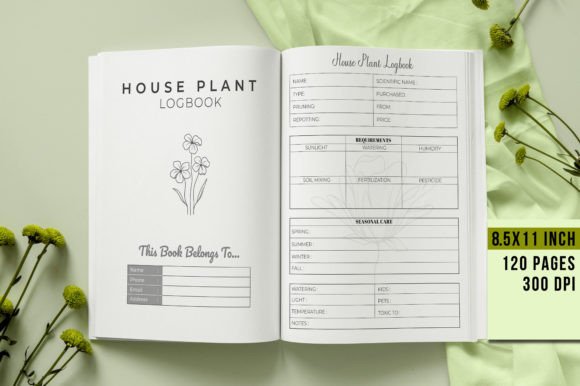
Also, consider the format that suits your style. Some people prefer very structured templates with predefined fields, while others thrive with more free-form space for sketches and lengthy observations. The product specifications of a well-designed logbook—like being 120 pages, sized at 8.5 x 11 inches—offer ample room for both structured data and creative notes. The large page size provides space for detailed entries, and the substantial page count ensures it will last for a long-term collection.
Finally, remember that the journal is a tool for learning, not a rulebook. Your entries should reflect what you actually observe, not what you think you should see. Be honest about mistakes—logging an overwatering incident is more valuable than ignoring it. This truthful record is what builds real expertise.
Bringing Your Plant Care Records into the Digital Realm
For those who operate in digital or commercial spaces, having a professional, ready-to-use digital version of a House Plant Journal Logbook is incredibly convenient. The product information highlights key features: it’s a single PDF file, formatted at 300 dpi for high-quality printing, with no bleed for clean edges, and is fully prepared for upload to platforms like Amazon KDP.
This makes it an excellent resource not just for individual use, but for creators and entrepreneurs. A blogger can purchase the PDF, print a copy for their personal use, and also use the design as a reference for their own content. An entrepreneur on Amazon KDP can upload it as a ready-to-sell physical journal product, offering a valuable tool to the growing community of plant lovers. The specifications ensure it meets professional publishing standards, requiring no additional graphic design work from the user.
The 8.5 x 11 inch size is standard and practical, easy to print at home or through a service, and comfortable to write in. The 120 pages offer a balance between longevity and affordability, providing enough space to track a sizable plant collection for a year or more. Being a single PDF file means it’s simple to store, share, and reprint if needed. These technical details translate directly into user-friendly benefits: reliability, quality, and ease of use.
Adapting the Journal to Your Unique Needs
The beauty of a house plant journal is its adaptability. You can strictly follow a template, or you can let it evolve with your practice. Perhaps you start by just logging water dates, then add a section for fertilizer notes, and later begin including photos or sketches. The ample pages encourage this evolution. It can serve a single hobbyist with a few pots, a serious collector with a greenhouse-like indoor space, or a professional needing to maintain client records.
Before committing to a specific journal format, think about your primary goal. Is it to simplify care for a small collection? Is it to conduct detailed experiments? Is it to create a beautiful archive of your plants' growth? Your goal will determine how you use the logbook. The described product, with its clean design and generous space, supports all these directions, providing a foundation that you can personalize.
In essence, a House Plant Journal Logbook is more than a notebook. It’s a companion in your gardening journey, a memory aid, a diagnostic tool, and a record of growth—both for your plants and for your own skills. By turning observation into recorded information, it empowers you to move from simply having plants to truly understanding and nurturing them, which is the ultimate reward for any plant lover.